THE INVENTOR: A Poet’s Transcolonial Autobiography
By Eileen R. Tabios
Publisher: Marsh Hawk Press (Chapter One Series)
Year of Publication: 2023
Price: $18.00
Distributors: IPG Book Distribution, Amazon, Ebay, Marsh Hawk Press, among others.
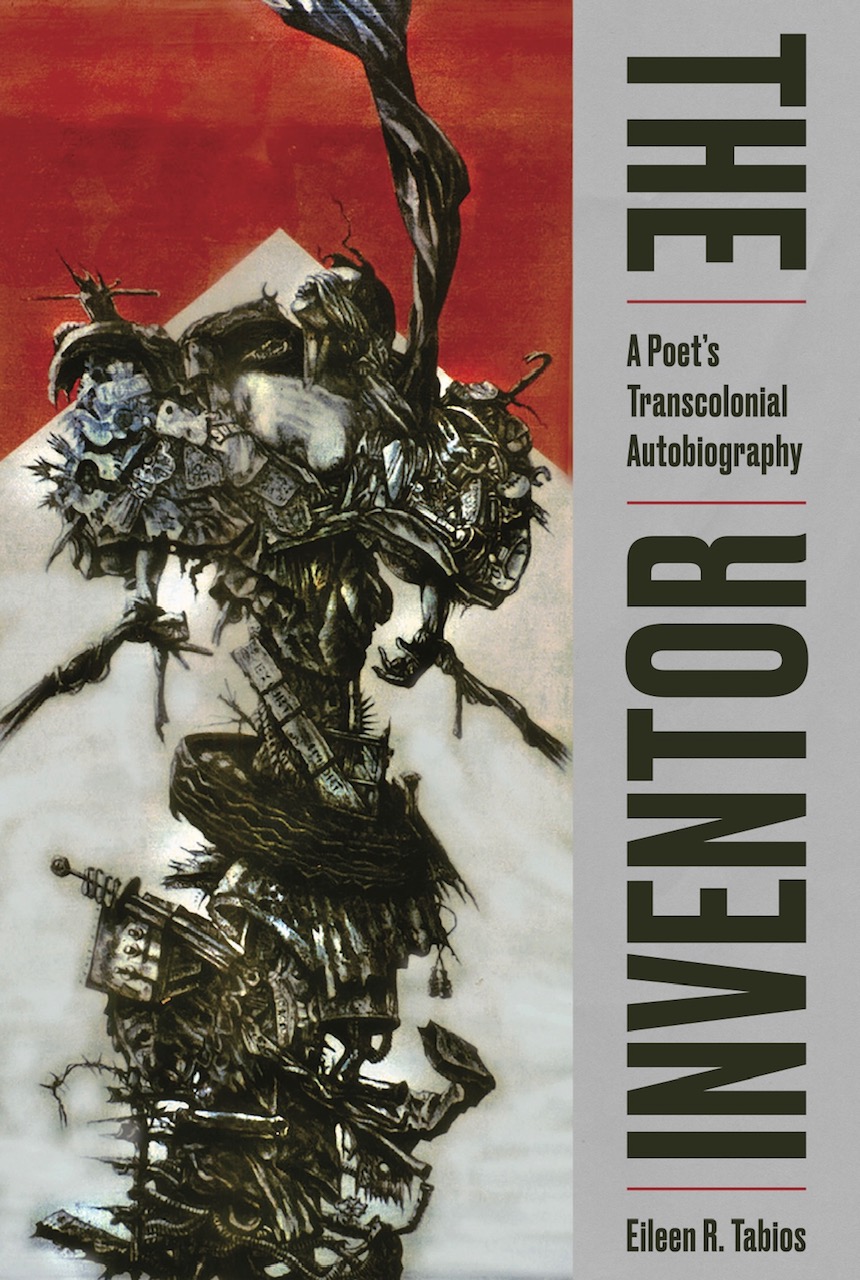
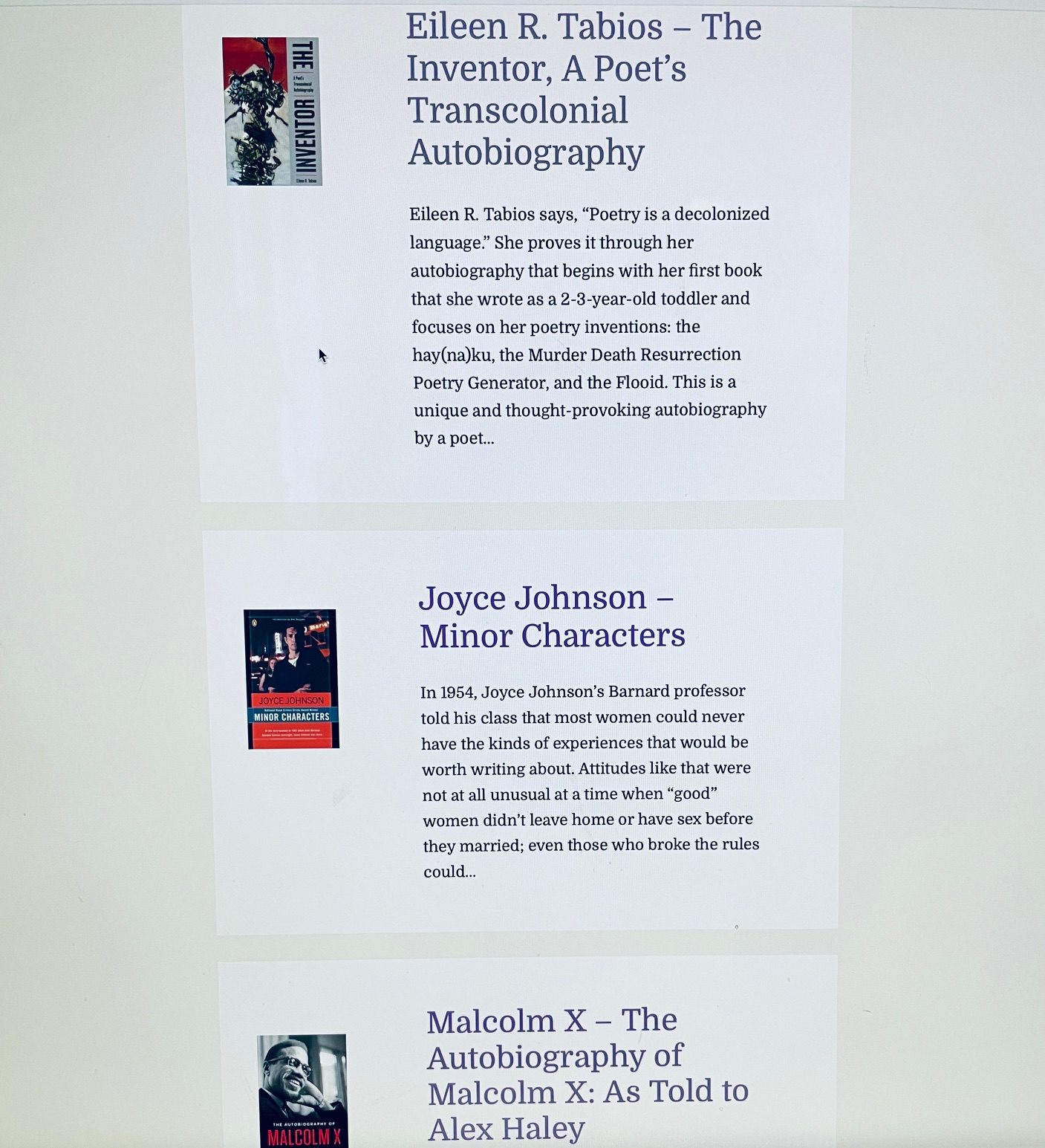
Cover Image: “Anghelpugay ng Kasarinlan (Elegiac Angel of Independence)” by Jose Tence Ruiz who created it for the Philippine Centennial Anniversary of the Philippines’ June 12, 1898 Declaration of Independence.
*
Publisher’s Book Description
Eileen R. Tabios says, “Poetry is a decolonized language.” She proves it through her autobiography that begins with her first book that she wrote as a 2-3-year-old toddler and focuses on her poetry inventions: the hay(na)ku, the Murder Death Resurrection Poetry Generator, and the Flooid. This is a unique and thought-provoking autobiography by a poet who claims poetry is not words.
*
Amazon Top New Release:
Author’s Note
I wrote THE INVENTOR, not because it’s about my life but, because it’s an autobiography that connects history, language, and poetry in a unique way beyond narratives. I learned English because it became widespread in my birth land, the Philippines, through U.S. colonialism. That caused me, as a young poet, to feel estranged from my raw material: English. My poetry practice, however, would lift me out of politics to meet poetry more directly as its own type of language. Ultimately, my prolonged engagement with poetry, enabled me to create poetry inventions that metaphorically disrupts colonialism by generating communities of readers and writers worldwide. These inventions include the “hay(na)ku” which has spread globally among poets and, most recently, the “Flooid” whose pre-writing condition precedent of a “good deed” makes poetry live redemptively and beyond the page. In THE INVENTOR, I show how Poetry is not mere words but a proactive approach to improving our relationships with each other and life on our planet.
*
Advance Words
In The Inventor: A Poet’s Transcolonial Autobiography, Eileen Tabios throws open the doors and windows of her poet’s house, inviting both longtime fans and new visitors to the writing behind the writing. Tabios opens with a description of her first book, written before the age of 3 and containing no words, and journeys through her life in language, sharing excerpts from her almost 100 (and counting) authored and edited books. While this book shares some similarities with other writers’ autobiographies, following Tabios’ route from journalism at The New York Times to a banking career to creative writing, it is as unique as Tabios’ poetic inventions, from hay(na)ku to the Flooid forms, to marrying poetry, and other singular approaches to inventing a life. Tabios is an icon of how to live an artistic, ethical, beautiful life with poetry, but not necessarily words, at its center.
—Grace Talusan, author of The Body Papers and Lecturer in the Nonfiction Writing Program, Brown University
Walter Benjamin once wrote, “No poem is intended for the reader, no picture for the beholder, no symphony for the listener.” I read Eileen Tabios work and thought of Benjamin’s words. Her poetry and prose—as generous as they are generative—are not meant for a specific reader but open themselves up to anyone who cares to read and think about them. In their decolonizing vocation, her writings follow from a tradition that stretches back to native writers such as Tomas Pinpin and Francisco Balagtas, winding their way through Jose Rizal, Jose Garcia Villa and Nick Joaquin, not so much to join a canon but precisely to shatter it. Proof of this is The Inventor, an autobiography that gathers fragments of her fulsome life to scatter it among no one in particular and everyone who might care to partake in its twists and turns.
—Vicente L. Rafael, author of The Sovereign Trickster: Death and Laughter in the Age of Duterte and Professor, University of Washington, Seattle
Eileen R. Tabios explains her term “transcolonial” as “wanting to trans-cend into other concerns or interests” beyond colonialism. As a Filipina native and U.S. immigrant, she illuminates essential questions about language as an agent of ethical and political concerns. She concludes by addressing the “good,” an aspect of poetics seldom considered by literary critics. This innovative word-wizard takes readers on a tour of experimentation and innovation in this readable story about powerful words and activism.
—Denise Low, author of The Turtle’s Beating Heart: One Family’s Story of Lenape Survival and Kansas Poet Laureate Emerita
*
Featured on “Listen & Be Heard,” WLBH Radio, Sept. 19, 2024
You can listen to the interview HERE with radio host and interviewer Martha Cinader.
*
AN EXCERPT is available on TRAVELS (and more) WITH CECILIA BRAINARD, Sept. 25, 2023.
*
Reviews and Reader Responses
This book tells the story of Tabios’ expanding awareness as a poet and an inventor in poetry. It is a narrative, but it also includes Theory. And it presents exciting new ways to actually make poems. It is, as it must be, political in several ways, just as its subtitle suggests. “A Poet’s Transcolonial Autobiography” insists that this story is the tale of recognition of and resistance to the colonizing forces in our lives as they range from armed occupation to economic exploitation and onward into our very uses of language and literary form. This autobiography unfolds the many ways in which Tabios has disciplined her writing into shapes and forms that can bridge or even defeat colonialisms….
The delights of this book come from its inventiveness in itself as a new kind of autobiography with a fresh approach to “person.” It also raises the essential issue of how poetry gets applied in our lives. The purposes here are somewhat “anti-personal,” but they are not without person and people at every level. Tabios’ approach loosens poetry from the grip of the personal and reaches into social and political dimensions through this loosening.
One of the very most delightful things about Tabios’ writings is the way they incorporate the lyrical personal “I” and concrete experience with “avant” considerations of form and diction. She clearly feels no need to resolve tensions between the two angles. She, instead, uses them both together to “triangulate” positions for creativity and thinking…. She writes: “I don’t feel poetry should sing so much as it should think. In poetry (unlike perhaps elsewhere), thinking is not the opposite of music and, indeed, concepts can sing.” In Tabios’ work, they do—as they blend the lyrical with the conceptual.
—T.C. Marshall, The Halo Halo Review, November 2024
This book was inspirational for me as a living poet who contemplates the transcendence of a poem and poetic form.”
—Martha Cinader, Listen&BeHeard, September 2024
“An essential book for those who follow innovative poetry and prose…. “Tabios succeeds in showing how we all might think through, build, and sustain art…. The real emphasis is on Tabios as a creator of forms…. witnessing [the hay(na)ku’s] origin story feels akin to being in the room when the first sonnet or tanka was written.”
—Rain Taxi Review, Summer 2024
The complicated discussion of poetry in The Inventor, A Poet’s Transcolonial Autobiography is a wonderful and complex view of poetry from many standpoints…. is packed with goodies that include definitions, references, examples and personal memories. Tabios guides the reader delicately over the quick sands that pull the poet and would be poet down and she raises the poems and poet safely to shore. // Each chapter is well researched. This is a book that should be in every serious writer’s library.
—North of Oxford, April 2024
For an author who has published more than 70 collections of poetry, fiction, and other writings, some of which are tomes, it at first may seem anomalous that Eileen R. Tabios’ autobiography is only 110 pages long. However, because the focus throughout is on her literary endeavors, The Inventor is quite streamlined. Yet the topics are discussed fully, and examples are plentiful. The Inventor is fundamentally a literary autobiography, in the tradition of works like Coleridge’s Biographia Literaria but without what some readers have perceived as the latter’s meandering topic coverage and prose style. This is no small achievement, considering that the principle of all of Tabios’ production is inclusivity. In the “Proem” to The Inventor, she approvingly quotes Philip Lamantia’s dictum, “There is no one way to be a poet.”
—Sandy Press, February 2024
Tabios, however, is unfailingly optimistic and idealistic. She suggests that poetry ‘can open you up to new modes of thinking/feeling/viewing . . . and hopefully then a newly better way of living’, despite understanding that ‘[t]his element about poetry—effecting positive change—is […] not based on the words that make up a poem. It’s not based on the visible, e.g. text.’ Some of this optimism is based on Tabios’ understand of and belief in Kapwa, a Filipino humanist philosophy which recognises a shared identity, an inner self, shared with others; or what Tabios calls the interconnectedness of things. // This puts a certain slant on things. Tabios seems more interested in the possible results and responses to writing and reading than the text itself.
—Tears in the Fence, December 2023
I will always be in debt to you for opening up Poetry for me, for the audacity to keep inventing something new and different from this borrowed tongue. Gratitude to you for going ‘transcolonial’!
—Leny M. Strobel
To be able to write again, I must forget that words are not just taught or thought of, but must be felt and acted on. That’s how I review The Inventor.
—Eunice Barbara C. Novio
Eileen R. Tabios says, “Poetry is a decolonized language.” She proves it through her autobiography that begins with her first book that she wrote as a 2-3-year-old toddler and focuses on her poetry inventions: the hay(na)ku, the Murder Death Resurrection Poetry Generator, and the Flooid. This is a unique and thought-provoking autobiography by a poet…itself.
—Listen & Be Heard Reading List
*
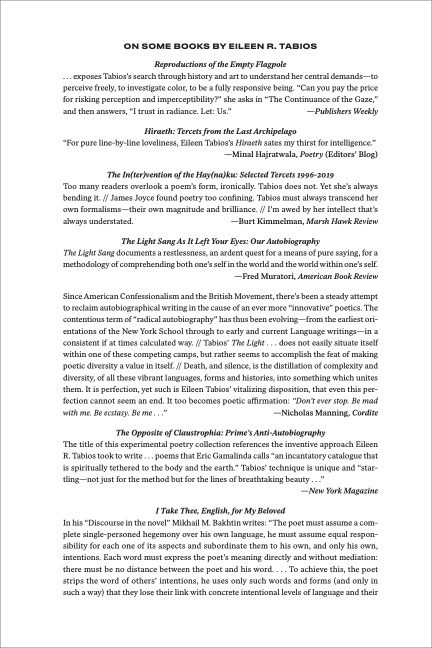
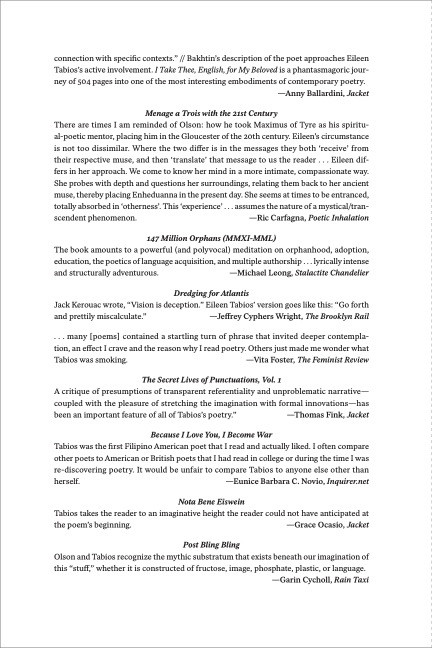
Previously on Eileen R. Tabios
Eileen Tabios’ gift as a poet is that she allows us space to perceive a myriad of human experiences: desire, loathing, horror, outrage, grief, love. It is this universality that awakens us—Always, always: to discern with compassion.
—Aileen Cassinetto, OurOwnVoice
Eileen Tabios has been a grand force in US poetry for twenty-five years or more, and it’s difficult to think of our own time without acknowledging what a large psychic space she has made for us. The sheer volume of her writing is impressive, like the rivers of Tigris and Euphrates; among postwar Americans, maybe only Leslie Scalapino, Steve Jonas, Alice Notley and Lew Ellingham have written so much with such assurance and endless, difficult-made-easy experimentation.
—Kevin Killian, Amazon.com
—Tabios tries for more in one page than many other poets would attempt in 20. And she pulls it off.
—Ron Silliman, Silliman’s Blog
Tabios has never been a poet to conform, she shatters the mirror. Its shards of images and words, both beautiful and harsh, of the comfortable and uncomfortable glitter like diamonds spilled out upon the floor.
—g emil reutter, North of Oxford
I once had a college classmate who was so exceptional that our professor exclaimed, with tongue-in-cheek, that she could submit a paper with absolutely nothing written on it and still receive the highest grade. I can easily say the same for artist, poet, writer, and publisher Eileen R. Tabios.
—Allen Gaborro, Philippine News
Occasionally, a writer or poet stuns me to silence, and Ms. Tabios accomplished that with ease. Her work is voluptuous, sensual, incredible impressionist brush strokes of words, colors, tastes, and scents. She believes poetry must burn, and burn it does in every possible way.
—Laurel Johnson, Midwest Book Review
Her passion and efforts for connection with the reader make all the difference here. Although Tabios is coming from a place of High Art, there is nothing ivory tower about her poetics. This is a balance that both the street poets and academics should be seeking if we are to revitalize our worth as poets.
—Joey Madia, New Mystics Review
Eileen R. Tabios is one of the more adventuresome and truly creative poets before the public today. She is absolutely able to write poems in the usual styles and make her works resonate with every reader. She always is searching for ways to push the use of words into formats or situation that challenge the brain as well as heart.
—Grady Harp, San Francisco Review of Books
Tabios’ concern for our world is global in its reach.
—Neil Leadbeater, Contemporary Literary Review India
 Eileen R. Tabios