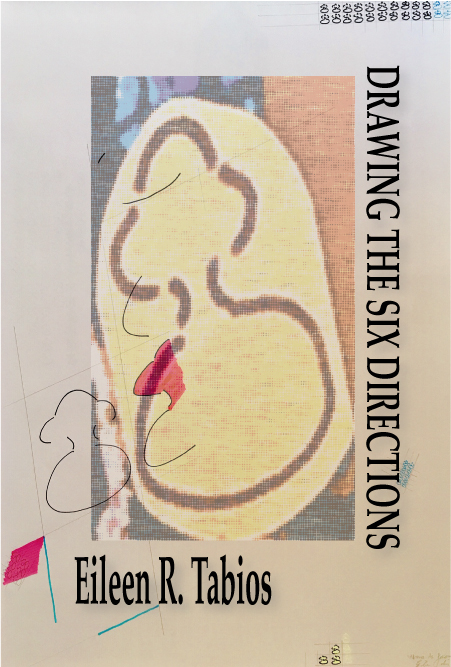
Release Date: 2024
Publisher: Sandy Press (Santa Barbara / Australia)
Order through Sandy Press at Amazon, Bookshop.org, Ebay, Barnes and Noble
Price: US$16.48
Pages: 86
Book Description:
Eileen R. Tabios began her “Poems Form/From the Six Directions” partly because she was trying to create a poem in a new way. Creating mixed-media sculptures whose processes engendered verse-poems fit that impetus. But, unexpectedly, the sculpting process made her focus for the first time on working with physical material. As a writer working with imagination and words, she was surprised by the pleasurable frisson of dealing with the tangible as found materials made their way into her mixed-media sculptures. Such materials included old coasters, used magazines, ribbons, recycled cardboard, department store shopping bags, and so on. The sculpting process created a “simmer” in her belly, like the physical effect she often feels when chasing down a poem into written form. She, therefore, decided to try her hand at working more consciously as a visual artist. She hadn’t intended to go this route but allowed herself to follow the impulse because such an “opening” manifested what she considers wonderful about all Art and Poetry: how they lead its maker and viewer/reader into new experiences. She would end up creating about a dozen sculptures before sculpting led her to drawing.
Her drawings and sculptures were just part of Six Directions, a multidisciplinary and interactive project that encompassed several performances, exhibitions, and readings in California’s Bay Area (San Francisco, Berkeley, and Sonoma). Because of her initial focus on the project’s interactive aspects with audience, the Six Directions drawings are the project’s least known element. This book offers the entire series of drawings, most of which have never been seen in public.
Advance Words:
“In her drawings, Eileen Tabios brings vibrantly colored multiple gourd patterns within diverse geometric ensembles into fruitfully diverse and dynamic compositional arrangements. Sometimes I recall suprematist canvases; at other times, the drawings hark back to the placement of stones in a Japanese garden.”
-Thomas Fink, poet-painter & author of Zeugma

Reader Responses:
“… perhaps the most impressive feature of Drawing the Six Directions is its cogent multitudinousness, starting with the title. “Drawing” does principally designate “the act of producing a visual representation,” but it can also mean “extracting” (e.g., “drawing water from a well”) and/or “pulling” (e.g. “Only one horse was drawing my carriage.”) As we read Tabios’ Six Directions poems and view her drawings one by one, and element by element within them, we extract their meanings, and we pull these meanings into our understanding of their contextual significance.
The contextual significance of the drawings, however, can’t be encapsulated in an identifier of any one period, style, or movement in visual art. At first, we might try to typecast the drawings as Suprematist, the extension of Abstractionism pioneered by Kazimir Malevich, that calls for simple geometric shapes (e.g., squares, circles but nothing as complex as icosahedrons) on white backgrounds to connote “pure feeling” (which can include spiritual experience), with no attempt to reference the physical world. However, the Six Directions drawings use light blue / light grey backgrounds to conjure not the intensity of “pure feeling” but on the contrary the placidity of a work like Paul Klee’s Winterbild (1930) or Jennifer K. Wofford’s MacArthur’s Nurses (2008). Again, Suprematist art works have palettes limited to, aside from white and black, primary colors; Six Directions drawings include, among others, browns, tans, and yellows.
Thomas Fink’s blurb suggestion about stone placement in a Japanese garden is more consonant with the effect of placidity that the Six Directions’ background colors create. Stones symbolize natural elements like mountains and islands. The stones’ arrangement is carefully designed to create a sense of balance, permanence, and stability and to guide a visitor through a landscape of spiritual and aesthetic meaning. In Zen gardens the landscape encourages peaceful reflection. The largest stones are placed first, and subsequent placements are proportional to the largest stones, a layout which creates an impression of anchorage and order. In Shinto tradition, the stones are even seen as possessing spiritual power (Kami) and their placement is designed to foster respect for, and connection to, nature. Nothing could be more removed from the effects of scenes that depict upheaval and violence [e.g. Goya’s painting Saturn Devouring His Son (1823) or Edvard Munch’s painting The Scream (1893)], conveying as it does existential dread and terror.
The stability and order that conduces to placidity in the Six Directions drawings can be attributed to a mathematical underpinning in them as well as in the order of nature. At the base of the mathematical element here is the “o” (the circle), which in the early going of the Six Directions drawings Tabios identifies as an emphasis: “I drew many circles because the circle is a simple image…” It is simple for the artist who draws it, but it is much more than a simple entity unless by “simple” we mean only “basic.” Apparently Max Gimblett, the Buddhist artist with whom Tabios spent considerable time, didn’t think it was simple in the sense of “simplistic” since he “frequently painted / drew the enso” [Japanese for “circle”].
The circle symbolizes eternity, since as a completed figure it has no discernible beginning or end. For the same reason, it symbolizes infinity. Because it is unbounded temporally and spatially, it is coterminous with the more concretely conceived concept of Kapwa: “everyone and everything has always been, is and will be connected to each other.” (DoveLion, 263)…
—Lynn M. Grow for The Halo Halo Review, May 2026 (Full review HERE)
The drawings themselves remind me of so many things. They are different from Aboriginal Australian drawings/paintings, but I was strangely reminded of them when I looked at the ones on pages 26-27, which made me think of Roeg’s Walkabout, because of the scale, the implied distances, the shape that looks like a mesa and the blue ones that could be a small pond. To me there’s an implied horizon to these two…
Other drawings make me think of some of the battle maps I used to draw as a younger person… Also the flattened perspective of Plains Indian paintings… some Thangka paintings I saw in Taos once, and some mail-art pieces I’ve received over the years…
—Scott MacLeod, poet & multi-faceted artist (total engagement can be seen HERE)
This book is fantastic! It’s brimming with the always-formidable creative force imbued in all of Eileen Tabios’ books. It’s inspiring me to write and create and only the best of the best writers can cause me to PUT DOWN their book because I feel the need to be creative. Eileen Tabios (especially this book) has this effect on me. I’ve been on a creative streak ever since reading it.
—Heath Brougher, poet, publisher & artist
“amazing and provocative creativity!”
—Phyllis Shaw, painter & scientist

