The Erotic Space Around Art Objects by Eileen R. Tabios with Art by harry k stammer
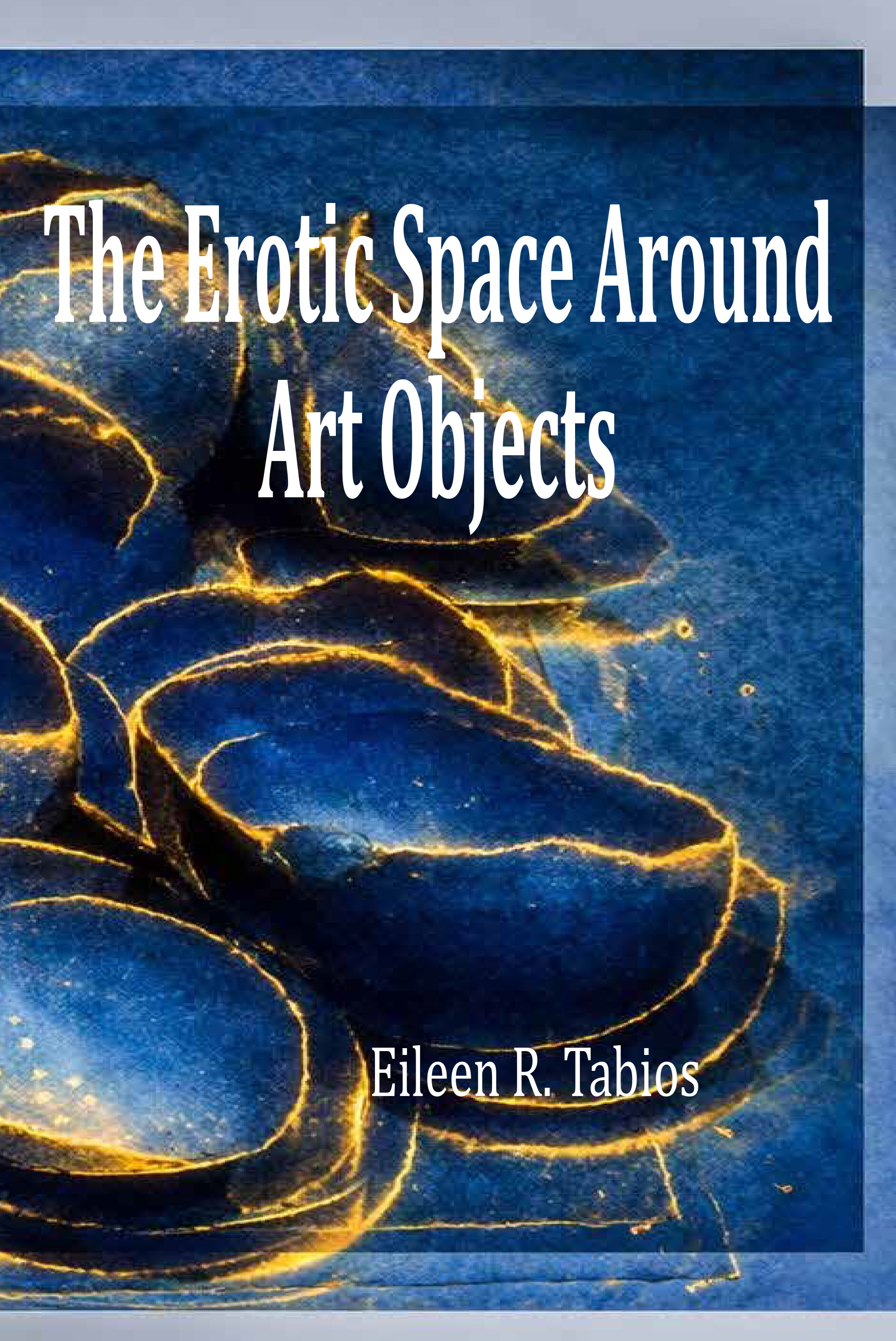
Publisher: Sandy Press (Santa Barbara, CA / Old Hill, Australia)
Release Date: 2026
ISBN: 978-8-9924582-9-9
Price: $12.00
Distributors: Sandy Press, Bookshop.org, Amazon.com, Ebay, Lulu.com, Kindle, among others
Book Description:
For philosophers like Plato, eros is a universal force that can be a vehicle for transforming consciousness towards peace, perfection and divinity. For psychologists like Freud, eros is the life force including the desire to live and thrive, sexual instincts, and basic impulses like thirst and hunger. From mythology, when Eros, the Greek god of love, fell in love, he had to overcome betrayal, envy, cruelty, deceit and even death to be united with his beloved Psyche. Reflecting the power of eros, Eileen R. Tabios in her short story collection, The Erotic Space Around Art Objects, radically eroticizes the “space” for interpreting visual art to create unique and unexpected narratives. The author radiantly shows the subjectivity and passion of aesthetic response in ways that elicit wonder while revealing a restless, multifaceted mind exploring the depths of humanity.
Marianne Villanueva, a short story master and author of Residents of the Deep, says about the collection: “Lush, erotic, feverish, philosophical, hallucinatory, audacious, passionate—this book demands surrender. Every scene is like attending a glittering cocktail party peopled with exotics who thirst for completion, who recklessly deny themselves nothing. Vivid and heartbreaking.”
In addition, Jean Vengua, artist and author of four poetry collections, notes: “Eileen R. Tabios’ stories are not predictable, and they swerve into poetry, even as a musical note might bend into blues. What makes these narratives blue? The fact that love exists, suffers and enjoys, alongside that which is distant, cold, calculating, imperative. ‘Keep your eyes open,’ commands the object of one artist’s desire in the story, ‘Blue Richard.’ In the midst of struggle—in the midst of cultural disjunction, diaspora, and subjection—the artist is drawn to the authoritative voice that makes everything seemingly easy, simple, fluid.”
~~
From an Interview with Cymbeline Villamin, The Halo Halo Review, May 2026
(Entire Interview HERE)
CV: In a culture that often demands ethical clarity from art, your stories remain deliberately ambivalent. What do you think literature loses when it is forced to justify desire?
ERT: To use your question’s terminology, some of my stories require ambivalence in order to hew to their particular ethical standards. Art has different ethical considerations from the ethics one might associate with other contexts.
To the question of what “literature loses when it is forced to justify desire,” I think that anytime literature is “forced to justify” something, the result depends on the author. That is, the literary result would reflect the author’s life perspective, intelligence, biases, writing skill, among others. The result can’t be generalized because the result can range from a diminution of the literary art to a beneficial effect from authorial expertise or experience that would enhance literary strength.
CV: Finally, if a reader finishes The Erotic Space Around Art Objects unsettled rather than satisfied, would you consider that a success?
ERT: Probably. Because from that unsettlement, a reader might grow. For works to expand a reader’s mindset is not an unusual effect desired by writers. Also, unsettlement as a reaction doesn’t necessarily bespeak a failure on the work’s part. A work fails when it’s met by indifference or apathy. Unsettlement—perhaps even hatred—still means the work had an impact. It’s not up to me as author to determine how the reader should respond. But, as author, I do hope that I create works that compel a response rather than a non-response.
~~
A Review:
‘The lengthy tale “The Caustic Surface” comes next. As usual in Tabios’ prose fiction, the title of the tale is telling yet withholding. “Caustic” in its literal sense means “capable of burning,” or “being eaten away by chemical reaction,” which is a technique an engraver might use, rather than corrosive chemicals, instead perhaps via laser, to create a caustic surface. By precision sculpting of a transparent material like acrylic or glass, an engraver can produce specific and complex caustics (light patterns) when light passes through it or reflects from it. Better known is encaustic painting, a related technique employing molten, beeswax–based paint to create heavily textured, layered surfaces. Ancient Greek painter Pausias (ca. 380-330 B.C.) used this approach, and much more recently (1954-1955) American Jasper Johns did in Flag. “Caustic” can also take the form of written or spoken acidic comments, e.g. James Bond to Tiffany Case in the 1972 film Diamonds are Forever: “That’s a quite nice little nothing you are almost wearing” (though Bond did immediately add “I approve”). / The tale’s narrative weaves together literary art and visual art, as the meanings of “caustic” suggest that it will with life as well.’
—Review by Lynn M. Grow, The Halo Halo Review, May 2026 (Entire Review HERE)

